
The Garden of Liberation
The 3D Interactive Educational Website
Date
Jan 2025 - Apr 2027
Contribution
UX/UI
Web Development
Animation/Motion Graphics
Team
Soyeon Lee

Context
What stories might be embedded in a plants' name?
This project began with a personal discovery: maehwa, a familiar plant in Korea, is commonly called the “Japanese apricot” in English.
This led me to Miseon-namu, a plant endemic to Korea whose scientific name, Abeliophyllum distichum Nakai, carries the name of Japanese botanist Takenoshin Nakai—a trace of Korea’s colonial history.
Through an interactive 3D experience, I explore the overlooked histories embedded in the names of plants.
My Role
As the lead experience designer, I am responsible for research, narrative and character design, visual development, 3D environment creation, web development, and technical iteration.
Bringing overlooked history back into the light
Gwangbok, the Korean word associated with national liberation, means “regaining the light.”
While scientific names are difficult to change under established naming conventions, this project brings the overlooked histories embedded within them back into view—and invites audiences to look more closely at the plants around us.
Beyond Korea:
A Shared History
Interest in Korean history extends beyond Korean audiences. The history embedded in plant names also connects to broader histories of colonialism, imperialism, and botanical classification around the world.

Experiencers
Who Are the
Target Audiences?
During my research, I found that this colonial history in botany remains relatively unknown, even among Korean audiences.
To make this overlooked history accessible beyond Korea, I designed the experience for both Korean and international audiences who may be unfamiliar with the story.

Project Goal
Create a meaningful and engaging learning experience that brings the colonial history embedded in Korean native plant names to life through immersive 3D storytelling.
Branding Design
Logo (Favicon)
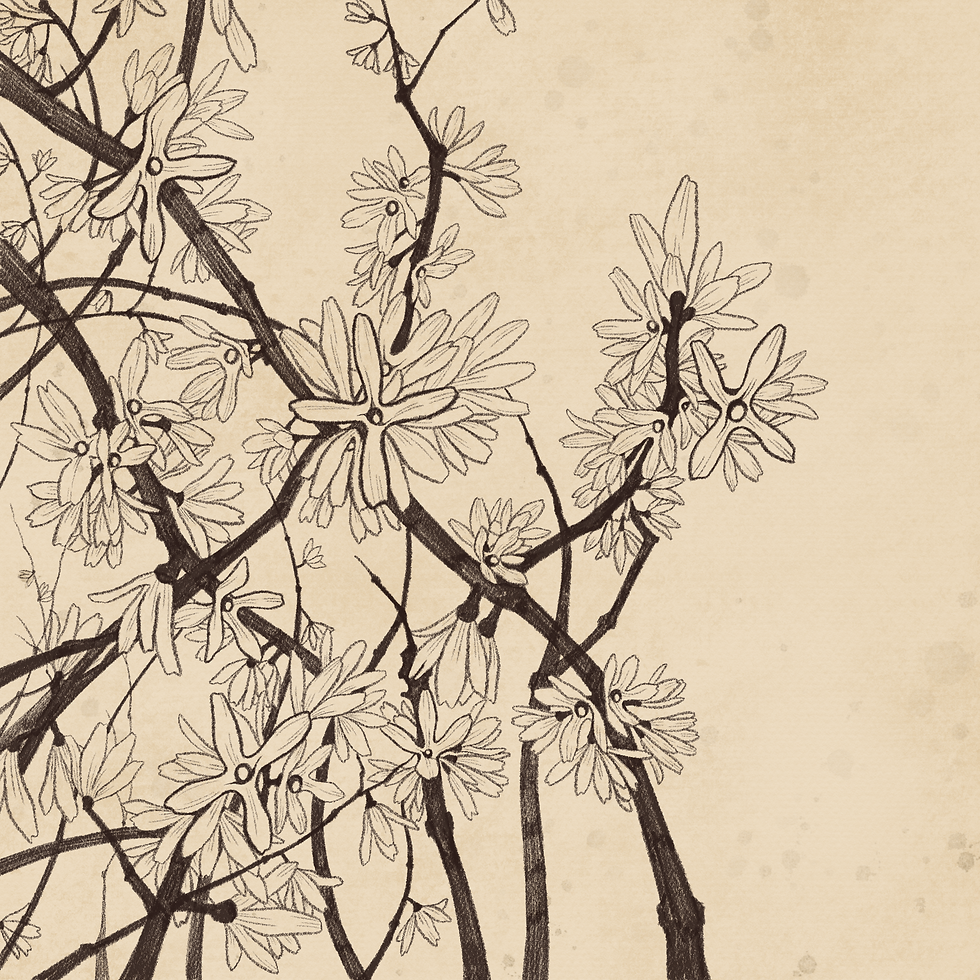
Inspired by the four-petaled flower of Miseon-namu and the graceful curves of traditional Korean architecture, the logo combines botanical and cultural symbolism in a minimalist form. Its design reflects the project’s themes of heritage, memory, and cultural identity.

Bringing a Hand-Drawn Voice into Digital Media
From the beginning of the project, I wanted the typography to carry my own visual voice rather than relying entirely on existing typefaces. I hand-drew the typography to create a distinctive, organic style, then converted the drawings into vector graphics for use as visual assets throughout the website.


Experience Design
The project is designed as a hybrid 3D interactive experience, beginning with an introductory webcomic and transitioning into a 3D environment structured around three narrative chapters. The experience also incorporates user choices that lead to different endings.
Each chapter explores a different layer of the story: imperialism in botanical history, Korean researchers’ efforts to document native plant names, and the cultural meaning of naming.

3D Environment Development
The 3D environment was created primarily in Cinema 4D, with its visual architecture inspired by Changdeokgung Palace, a traditional Korean palace. Cinema 4D allowed me to efficiently model, texture, and prepare the environment for integration into the web experience.

3D Website Development
The interactive 3D website was developed using React, React Three Fiber, Three.js, Node.js, and Vite. The 3D assets were exported as GLTF/GLB files and integrated into the web environment to create an interactive, browser-based experience.


Character Design
"We need to find our way back home!"
To create an immersive storytelling experience, I designed five key characters: Soyeon, the protagonist; her mother; Nakai, a Japanese botanist; Chang Hyung-doo, a Korean botanist; and a foreign couple.
Synopsis
Soyeon visits Changdeokgung Palace with her mother and becomes curious about a beautiful flowering tree after overhearing a foreign couple wondering about its name. While searching for its Korean name, she is mysteriously transported to a hidden, dreamlike garden, where she must uncover its forgotten history to find her way back home.


Standing Illustrations (UI)


Webcomic




Design System

Technical Implementation
Web Optimization
I used Draco compression and GLTFJSX to optimize 3D assets for browser-based performance. Because the experience relies heavily on real-time 3D environments, reducing asset size and improving web performance were essential for creating a smoother and more manageable experience.
Draco: https://google.github.io/draco/
GLTFJSX: https://github.com/pmndrs/gltfjsx#usage
AI-Assisted Prototyping
I used AI-assisted prototyping to accelerate technical iteration and implementation. Before incorporating AI, I defined the project’s technology stack, core functions, user flow, narrative flow, and overall website architecture.
With these foundations established, I used AI to rapidly prototype and test technical solutions.
I then debugged, refined, and optimized the implementation while identifying solutions for challenges specific to building an interactive 3D web experience.
Explore the Experience
Experience the interactive 3D educational website.
For the best experience, please view it on a desktop browser.
References
Vibe Nielsen (2023). The colonial roots of botany – legacies of empire in the botanic
gardens of Oxford and Kew, Museum Management and Curatorship, 38:6, 696-712,
DOI: 10.1080/09647775.2023.2269222
Lee, J. (2012). Contested Botanizing in colonial Korea (1910–1945): Conflicting
Visions of Modernity Emerging through Colonial Interactions between Korean and
Japanese researchers [Doctoral dissertation, Seoul National University].
Interdisciplinary Program in History and Philosophy of Science.
Cho, M., Lee, W., & Choi, S. (2018). The Origin of Korean Plant Common Names,
Seen through an Examination of the “Determination Principles” of Joseon singmul
hyangmyeongjip. The Korean Journal for the History of Science, 40(3), 551-607.
Chang, C.-S., H. Kim, & K.S. Chang. (2015). Botanical Gazetteer for Korean
Peninsula Flora. Designpost, Goyang-si (in Korean).
Schiebinger, L. (2004). Plants and Empire: Colonial Bioprospecting in the AtlanticWorld. Harvard University Press. https://doi.org/10.2307/j.ctvk12qdh
Korean historical Book: Notable Figures of Manguri Park
This book highlights the life of Chang Hyung Doo, portraying him as a botanist and nationalist who contributed to Korean botany and supported the formation of The Joseon Museum Research Society.
Botanical Book: Where Plant Names Come From
This book traces the origins of Korean plant names through historical records, scholarly research, and author’s field explorations.
Botanical Book: Origin of Korean Plant Common Names: Annotated Joseon sigmul hyangmyeongjip
This book is the result of seven years of research by modern scholars, comprehensively compiling and systematizing the national and scientific names of Korean plants based on Joseon Sigmul Hyangmyeongjip, a historical botanical source.
Korean historical Book: Korea’s Place in the Sun Recommended by a history professor, this book provides an overview of Korean history from a foreign scholar’s viewpoint. Chapter 3 specifically addresses the Japanese colonial period.
How Did the Korean Endemic Diamond Bluebell Become the Japanese Name
“Hanabusaya Nakai”? (YouTube
documentary). https://youtu.be/RwMutrWoNyk?si=O6N1Q9AdyuB0DxFl
Chang Hyung Doo and Our Native Plants (YouTube
documentary). https://youtu.be/qRuUOstrr5U?si=gRPTzP087f-G57Os